

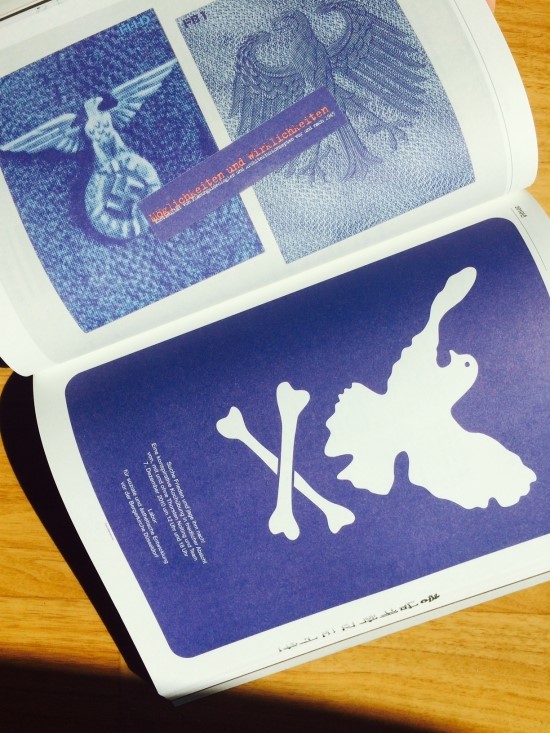
Reading Designers, Designers, I found it genuinely enjoyable.
Maybe it was the range of thoughts and personalities that came through in the short interviews with different designers,
or maybe it was a few realizations I found buried in their advice.
Either way, I found three things in this book.
- A Sense of Direction
You can teach the principles of design, its history, the evolution of context.
A student becomes a designer only when they internalize those principles
and try to develop them into the voice of their own life.
- Isabel Swiderski
Let's call the first one a sense of direction. The book is structured as interviews that look back at many designers' past projects alongside their current ones,
so a thread naturally emerges connecting the past to the present.
Looking at their work, the saying that people don't change easily really hits home. All of it seems to be a pursuit of something they were each individually
drawn to.
I used to have a vague misconception I carried around without questioning it: that to be skilled in a field, you had to be good at everything. As a designer,
I thought that meant drawing illustrations well, producing beautiful calligraphy, and nailing editorial design too. Of course, if you could be a "genius"
who's great at everything, that would be wonderful, but really you only ever end up with a handful of areas where your personal taste and strengths combine and
get maximized. And if it's even possible to grow into that kind of "genius," I think it's only possible on the premise of staying faithful to the fundamentals
that run through every corner of design.
In design, what matters most is still "the fundamentals," and growing yourself on top of that according to your own direction seems to be the
rest of it. I had a teacher who helped me open the door to design. She once told me that the difference between web design and editorial design is just
the medium you present it through, and that the essence of design itself never changes. I take that as advice to stay faithful to the fundamentals no matter
what kind of design you do. After that, the next step is finding your own dartboard, the thing you want to pin yourself to.
- Direction of Travel
It's important to learn the rules so you can break them,
and it's important to learn history so you can understand your own role within it.
- Letana Grow
The second thing is direction of travel. Both the first and second points are pretty abstract. What I mean by direction here is, as someone studying
design, where you choose to plant each step as you move forward.
The book poses good questions to the designers: advice or warnings they'd give students, and the qualities a design professional should have. There were
plenty of witty answers, useful answers, and answers worth sitting with for a while.
What struck me most was the part about studying the history of design. The book doesn't spell it out in detail, but I think this is really about
"breaking convention." There's nothing new under the sun, and what we now call new seems to depend entirely on how you recombine what already exists.
If you wanted to make the most original, newest ballpoint pen in the world, the first thing you'd have to do is find out what ballpoint pens already
existed. In that same sense, being told to study history feels like the first button you fasten toward new, creative design. And after that, again,
it's about finding the dartboard you want to pin yourself to.
- Six Years and Nine and a Half Hours
On average, a design student remembers wanting to become a designer at sixteen years and nine months old. They woke up
every morning at 8:46, got around by bike, loved pasta, and weighed 65 kilograms, a remarkable feat considering they never
exercised at all. A design student's most prized possession was their computer, and they studied for roughly six years
and three months. They never once considered doing anything besides design, and devoted at least nine and a half hours a day to it.
They were influenced by design masters like Neville Brody and Wolfgang Weingart, by the Fluxus art movement,
by artists like Marcel Duchamp and Saul Bass, and read Marshall McLuhan's books.
In the evenings, they liked to watch David Lynch films.
You hear a lot of talk about TOEIC scores and TOEFL scores. Wouldn't it be convenient if being good at design could be quantified the same way? Actually,
no. If it could, we might end up with cram schools flourishing on the promise of guaranteed high scores on some "design proficiency exam," and a kind
of skill inflation setting in.
Because design can't be quantified like that, it's genuinely hard to gauge your own skill level. It's a bit like when a game launches with no visible
loading bar and you assume it's frozen; as someone studying design, when you can't feel yourself improving, you start to assume you just don't have
the talent for it. But the book did offer something of a benchmark.
Many of the designers introduced in the book studied design for about six years on average, and spent nine and a half hours a day on it. If you haven't
yet put in six years of nine-and-a-half-hour days, maybe you don't need to be so quick to judge yourself. At the very least, it seems studying design
doesn't show results the way an energy drink kicks in fast. We probably need to hold onto a bit more confidence and resolve.
Designers, Designers