Do you remember "Road" ("길"), the title track from GOD's fourth album back in 2004?
I don't know where this road I'm walking leads,
I don't know where it's taking me, or what that place even is,
I don't know, I don't know, but still I keep on walking
The lyrics of "Road" resonated deeply with young people who were struggling to find their way at the time. Riding that wave, GOD swept the year end award ceremonies of all three major broadcasters in 2004. The lyrics really do hit home. I said earlier that they especially resonated with young people, but in truth, people of every age probably shared in the feeling the song carried. That's because our concern for the present and the future is a serious question that transcends any era or generation. From the dawn of humanity to today's industrial societies, everyone has continually wrestled with the question of their own existence and the direction of their life. We're no different now.

So where should we go? To find a hint, the first thing we need to do, as the saying goes, is look for our way in history: examine who we are and what path we've walked so far. Only once we've investigated the essential nature of the subject facing the problem can we choose a better direction. So the question we really need to sit with is: who are we, where did we come from, and where are we going?
This question matters everywhere, for individuals and across every corner of society, but it's especially necessary in the field of design, which sits closely connected to so many other domains. Many well known designers have offered their own definitions of design, drawn from their personal experience and achievements, and professional institutions produce countless new designers every year. Tools and workflows have advanced a great deal too, but many design researchers still argue that we need far more reflection and study on the fundamentally vague concept of what design actually is.
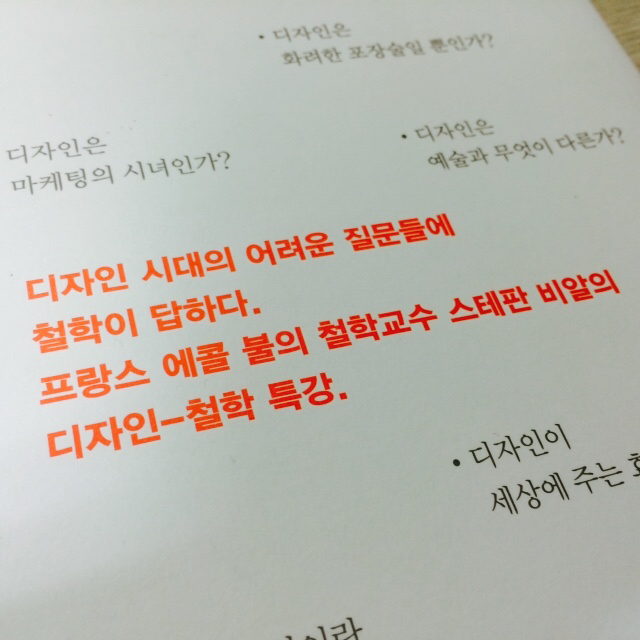
Stéphane Vial's A Philosopher's Study of Design is exactly the kind of work that approaches the question from this angle. Vial is a professor of design at the University of Nîmes in France, and he studies digital technology and design from a philosopher's standpoint. Maybe that's why his approach to each concept digs all the way down to a word's etymology, even the intent of the person who coined it. Here's an example.
The expression "interactive design" can only be considered valid in the sense Bill Moggridge intended when he used it to replace the term "interface design." So what, then, is an interface?
The term was borrowed from English, and originally referred to the surface formed as a shared boundary between two entities. p.106
In this same manner, he works methodically through the major concepts, the history of design, its meaning, its effects, backing each one with fitting citations and insight. It's never dull or dry; if anything, I found it genuinely engaging. Along the way, you also get to see his own proof and reflection on what design is. He returns several times to the paradox of design: how it was born with a socially formative character through William Morris, yet grew to maturity on the back of massive capital systems. From that paradox, you can glimpse both how designers create and where design might be headed.
To sum up the thread of the argument briefly: the essential, original nature of design is to serve as a means of building a better society. Because of that, design shouldn't just be a driving force behind innovation, it should aim to be the innovation itself, all while pursuing ethics and aesthetics at the same time.
The time has come for designers to show the way.
Because, as the book puts it, "this is a design problem: eighty percent of the
environmental impact any product, service, or system will ever have is decided at the concept stage." p.126

According to Tim Brown, twentieth century designers, centered on aesthetics,
image, and trend, formed a kind of priesthood: figures in black turtlenecks and designer glasses, working on trivial things.
Twenty first century designers, by contrast, need to become systems thinkers who reimagine the world, and in doing so, finally
bring about human centered design. p.133
What I found especially interesting was the discussion of marketing and design. I mentioned in a review of another book not long ago that the boundaries between marketing, design, and development are dissolving, and that this is a trend in the advertising industry. Vial, on this point, draws a clear line between marketing and design, taking the ethical position that for design, the market should be a means, not an end. He also insists that designers hold firmly to an ethical stance. At the same time, he acknowledges that design can never fully separate itself from industry, and quotes the following line to make that point.
"The question is not whether we are bad people because we are designers, but what we can do with that fact, given that we are designers." p.59
When the book quotes a line like "act so that your actions align with the permanence of a truly human life on this earth" as a motto designers should recite daily, it does make me think it's asking a bit too much nobility of designers. But that's probably exactly because of how strongly the author believes in the value of what design and designers do. The thought provoking lines scattered through the middle of the book made me reconsider my own sense of purpose and the value of my work.
The foreword of A Philosopher's Study of Design describes it as "a short reflection on design." The book is as compact and light as that short foreword suggests. But its content is anything but light: it sets out a way to distinguish design from what isn't design, and gives you real ground to reflect on what design fundamentally is. So what is design, where did it come from, and where is it going? If you want to sketch out that outline for yourself, I'd recommend this book without hesitation.
A Philosopher's Study of Design