I did my military service at an air force base in Yecheon, North Gyeongsang Province. Surrounded by farmland, the mountains and sky there were unusually blue, and I got to spend a not-so-short twenty-five months immersed in the beauty of nature. It left a real mark on me, and I think that had a lot to do with the fact that around that time I was absorbed in Thoreau's Walden, his record of two years spent living by Walden Pond. Then again, maybe it also traces back to my childhood, growing up in a countryside elementary and middle school that only ever had one class per grade.
Watching nature change slowly like that, I came to a new realization: that everything, truly, reaps what it sows. Of course this is such an obvious, unchanging truth that it feels almost embarrassing to state it. But knowing something and actually being aware of it while living your life are two different things. Once you become aware of it, I think, the moment a plant blooms stops feeling like an ordinary law of nature and starts feeling astonishing and wondrous instead. A seed takes root, draws nutrients from the soil, grows leaves, blooms, meets a bee, and eventually gives rise to the seed of new life all over again; the interplay of each of these steps is clearly a combination with a reason behind it, a coincidence that isn't really a coincidence at all.
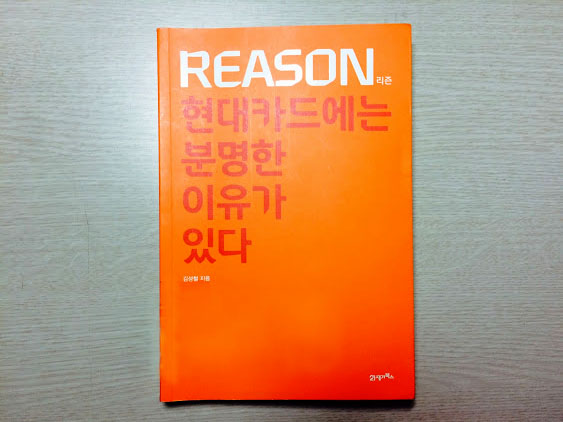
Hyundai Card Has a Clear Reason, written by Kim Sung-chul, the advertising professional behind most of Hyundai Card's ads, unpacks exactly how the seed that is Hyundai Card bloomed into the flower it is today and keeps propagating itself, viewed through that same lens of "awareness." If you assumed the brand's success was inevitable simply because it has the Hyundai name behind it, or that it was just the successful outcome of design-driven management, the author says that's not quite right. As I made my way slowly through the book, three things stood out to me, and I want to share a few thoughts on each.
- Breaking Convention
The process of finding an answer is the destruction of a frame beyond what you can imagine.
There's no confinement to genre, no limit to methodology. p.153
Ten years ago, Hyundai Card was a late entrant to the industry, and every single day felt like a matter of survival. If the goal was survival, simply chasing the competitors already ahead didn't seem like it would help much. So instead, they started overturning the card industry's cookie-cutter conventions one by one, and redrew the whole board: Hyundai Card, or not Hyundai Card.
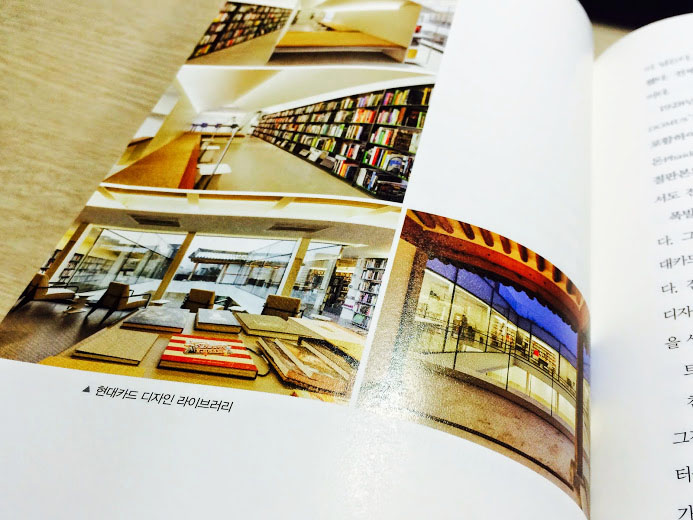

Hyundai Card started by fixing the reward-point system that, across the entire industry, had until then been little more than a facade. They then became the first in the industry to build out individual sub-brands, successfully launching everything from the M series to a whole alphabet of series. They put on concerts featuring world-class stars, built a design library, donated design work for things like the bus stop in front of Seoul Station, and even made kitchenware, doing so many things that you start to wonder whether they're actually a credit card company at all. If none of that quite lands, it might help to recall "MC Sidetrack," the Hyundai Card ad from last year that caused a sensation.
These points of differentiation seem to have settled into an identity all their own: "that's so Hyundai Card." It's gotten to the point where seeing some unusually striking performance or ad makes you wonder, "is this a Hyundai Card thing?" Looking back at history, every new era has arrived by breaking the conventions that came before it. That's true of modern society after the Industrial Revolution, and it's true of Joseon rising from the collapse of Goryeo. But the catch is that if you don't keep breaking convention on your own terms, sooner or later something else will break it for you. In that sense, the fact that Hyundai Card has spent the past ten years continually breaking and remaking itself seems to be the single most powerful, distinctive principle behind everything the Hyundai Card era has made possible.
- Design in Service of Essence
Makeup is necessary for branding, but
meaningless decoration is nothing but waste. p.88
Hyundai Card is actually a well-known company among designers too. It has a distinctive corporate culture, and even though it's not a design company, it produces design that's as polished and substantial in scale as what you'd find at any dedicated design firm, which makes it one of the places skilled designers keep an eye on.
Watching them design every last little detail, you can't help but be impressed. They design the water bottles used at events, of course, but the stories go as far as shortening the front desk staff's pants to match the M's mini concept, and even thinking through the sock design to match.
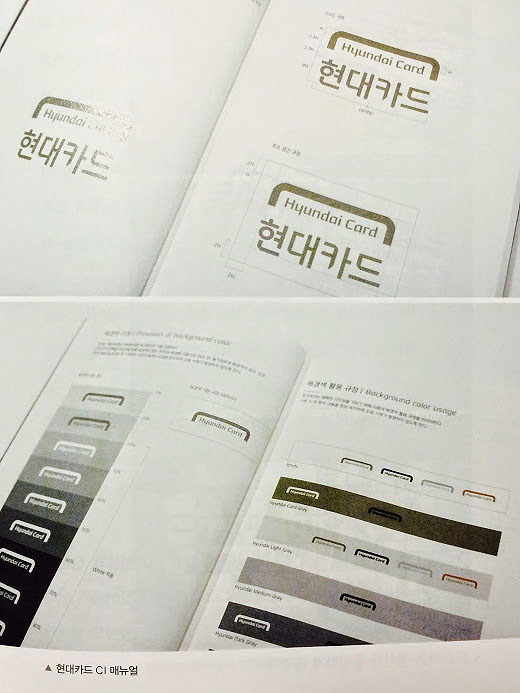
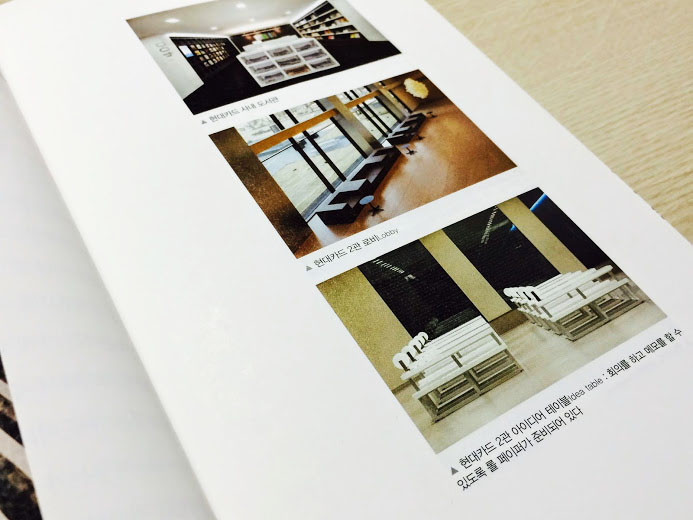
"There are people who say, 'why does it matter so much whether a finance company does good design.' But we think it's precisely because we're a finance company that we need to do design well. As I mentioned earlier, finance is something everyone genuinely needs in life, but a lot of people misunderstand it as something difficult, something that has nothing much to do with them, and so sometimes see it as negative, sometimes as unnecessary." - from the Hyundai Card blog
I came across a post on the Hyundai Card blog that summed up their thinking on design well. Reading it, I got the sense that even though they place enormous value on design and apply it to almost everything, all of it is in service of design as a tool that helps people understand and connect with the Hyundai Card brand better. The book made similar points that caught my eye.
Everyone is throwing themselves into design these days, but what set Hyundai Card's path apart is the fact that they never once did
"design for design's sake," not for a single moment. They simply always chose whatever design best expressed the product
characteristics each card had. p.26
By definition, design is always made for some specific purpose. And yet plenty of people still dismiss it as nothing more than packaging. Because Hyundai Card's success with design has drawn so much attention, apparently font foundries get a lot of requests from other companies wanting their own custom typeface, just like Hyundai Card has. But whether those companies can actually carry a Hyundai Card-level design mindset and manage it the same way is another question.
As more and more designers enter the field, and as society's push to make use of design grows more active, it's probably unavoidable that design competing purely on beautiful, emotionally captivating surfaces will keep appearing. But making sure that emotional appeal has a reason behind it, the way Hyundai Card pursues it, might be exactly the role that falls to designers going forward.
- Existing on Your Own Terms, Being Alive
We resolved to copy and paste, but never lose Hyundai Card's own standards, and in the process of
refining that, Hyundai Card's own color gradually began to take hold. p.263
In the film Boyhood, shot over twelve years, you watch child actor Ellar Coltrane actually grow up on screen. His face changes little by little, yet you can still feel the same underlying impression throughout. The changes that come with growing up aren't separate, disconnected things from what came before; every changing moment, every stage of the process, carries a single continuous thread simply by virtue of existing.
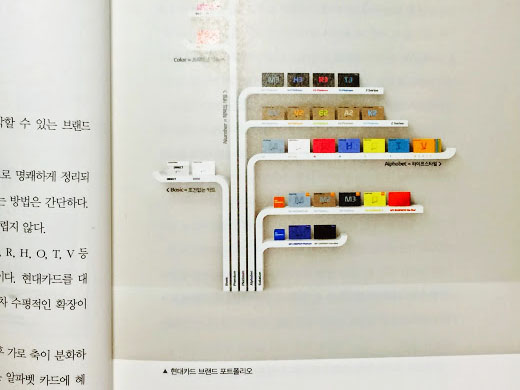
A brand also carries a consistent thread through time. But unlike a person's natural growth, a brand can be positioned into a particular shape. That means it can respond to the market according to strategy and circumstance, but it also means that without a clear set of principles or a vision, it's easy to just drift along with whatever's trendy. That's exactly what makes Hyundai Card impressive: for ten years, long enough that the saying goes even mountains and rivers change, they kept speaking in the same voice without wavering.
They protect their brand identity thoroughly, and make sure every area of internal work is built on top of their philosophy. Hyundai Card has a program called the Insight Trip, which sends employees traveling to pick up new inspiration. The program itself reflects that philosophy, but so does everything downstream of it, all the way through the process of reprocessing whatever information and ideas they bring back so that it comes out feeling "like Hyundai Card."
A powerful brand is the product of accumulation. Nothing matters more than never losing your own principles and holding onto your own posture and perspective. It's only by keeping your own pace while building up new experience that you can become a truly good brand. p.125
Both the convention-breaking and the design I mentioned earlier are also products of Hyundai Card pursuing its own brand philosophy: "we set our own new standard." Reading through all these varied, interesting branding examples in the book, I found myself thinking that Hyundai Card as a brand feels almost like a living, breathing organism. Every living thing is special in its own right; even members of the same species are unique beings, each with their own particular traits. I think that's why Hyundai Card, constantly pursuing change while at the same time consistently holding onto its own distinct point of view, felt similar to that to me.
There's a lesson we can take from this point, and it's about ourselves. Living in such a fiercely competitive society, we seem to forget that we ourselves are special beings. Buffeted by whatever's trending around us, we may be underestimating, far more than we realize, the values and possibilities we pursue as designers or artists. And this despite the fact that Picasso and Van Gogh, the artists we all admire, were people who relentlessly pursued a world of painting entirely their own.
If you become too preoccupied with your opponent purely to score points, you end up losing even what you already had. The fiercer the fight, the more you need the focus to stay absorbed in yourself. p.266
This reminds me of some advice singer Wheesung once gave on a TV show. He said that if you don't chase trends and just keep doing what you're best at, eventually the trend cycles back around and lines up with you, and that it's worth building up your own strength and waiting until that moment comes, holding onto your own perspective the whole time. It probably doesn't apply to every field, but it seems worth sitting with for a while. It's only when we don't forget who we are that we can really say we exist, that we're truly alive.
Seeing the title, you might have wondered why a marketing book showed up in a design book review column. But when I was choosing this book, I thought that looking closely at Hyundai Card, a brand with such a solidly established identity, would turn out to be genuinely meaningful. Hyundai Card is now an influential brand that's shown up repeatedly even in Monthly Design magazine, and examining the philosophy behind it can give us insight into what actually works in the world, and by extension, what we ourselves should be doing. What's more, at a moment when the boundaries between design and other fields are dissolving, thinking that design should only be studied within design itself is bound to be a way of isolating yourself.
Reason: Hyundai Card Has a Clear Reason